Quantum Computing Impact on Encryption: What 2026 Holds
Anúncios
By 2026, quantum computing is poised to fundamentally reshape encryption, threatening current security protocols and necessitating a rapid transition to quantum-resistant cryptographic solutions to safeguard sensitive data.
Anúncios
The advent of quantum computing promises to revolutionize various fields, but its potential to break modern encryption algorithms presents a significant challenge to digital security. Understanding the impact of quantum computing on encryption: what 2026 holds for your data is no longer a futuristic speculation, but an immediate concern for individuals, businesses, and governments alike. This article delves into the impending shift, exploring the vulnerabilities, emerging solutions, and the urgent need for preparedness.
The Dawn of Quantum Computing: A Double-Edged Sword
Quantum computing, leveraging the principles of quantum mechanics, offers processing power far beyond classical computers. While it holds immense promise for scientific discovery, medicine, and artificial intelligence, its ability to factor large numbers quickly poses a direct threat to the cryptographic foundations underpinning our digital world. This duality makes quantum computing a double-edged sword, capable of both unprecedented advancement and profound disruption.
At its core, quantum computing utilizes qubits, which can represent both 0 and 1 simultaneously, unlike classical bits. This allows quantum computers to perform complex calculations in parallel, dramatically accelerating certain types of problem-solving. For cryptography, this means algorithms previously considered secure against brute-force attacks may soon become trivial to crack.
Shor’s Algorithm and RSA Encryption
One of the most significant quantum algorithms, Shor’s algorithm, can efficiently factor large numbers. This is particularly problematic for RSA encryption, a cornerstone of internet security.
- RSA Encryption: Relies on the difficulty of factoring the product of two large prime numbers.
- Shor’s Algorithm: Can factor these numbers exponentially faster than classical computers.
- Implication: Websites, secure communications, and financial transactions protected by RSA could be compromised.
The implications of Shor’s algorithm extend beyond RSA to other public-key cryptosystems that depend on similar mathematical problems. As quantum hardware continues to evolve, the timeline for these threats becomes increasingly compressed, making proactive measures essential rather than merely advisable.
The rapid progression in quantum technology means that the theoretical threats are quickly becoming practical concerns. Governments and major corporations are already investing heavily in quantum research, signaling the seriousness with which this potential disruption is being taken. Preparing for this future requires not just understanding the technology but also developing robust defensive strategies.
Anúncios
Current Encryption Vulnerabilities in a Quantum World
Our digital lives are built upon layers of encryption, safeguarding everything from email and banking to national security communications. However, many of these widely used cryptographic standards are vulnerable to attacks from sufficiently powerful quantum computers. The sheer computational power of these machines could render current protections obsolete, opening a Pandora’s box of privacy and security breaches.
The primary concern lies with public-key cryptography, which is used for secure communication channels, digital signatures, and key exchange. These systems are designed with the assumption that certain mathematical problems are computationally intractable for classical computers. Quantum computers challenge this fundamental assumption.
Elliptic Curve Cryptography (ECC)
Another prevalent public-key system, Elliptic Curve Cryptography (ECC), is also at risk. ECC is favored for its efficiency, offering high security with shorter key lengths.
- ECC’s Strength: Based on the difficulty of solving the elliptic curve discrete logarithm problem.
- Quantum Threat: Grover’s algorithm can significantly speed up the search for solutions, albeit not as dramatically as Shor’s for factoring.
- Impact: While less direct than Shor’s impact on RSA, ECC’s security margin is still reduced to a point where it becomes vulnerable.
Beyond public-key systems, symmetric encryption algorithms like AES (Advanced Encryption Standard) are also affected, though to a lesser extent. Grover’s algorithm can reduce the effective key length of symmetric ciphers by half. This means that a 256-bit AES key would offer the security of a 128-bit key against a quantum attack, still formidable but requiring larger key sizes for equivalent future protection.
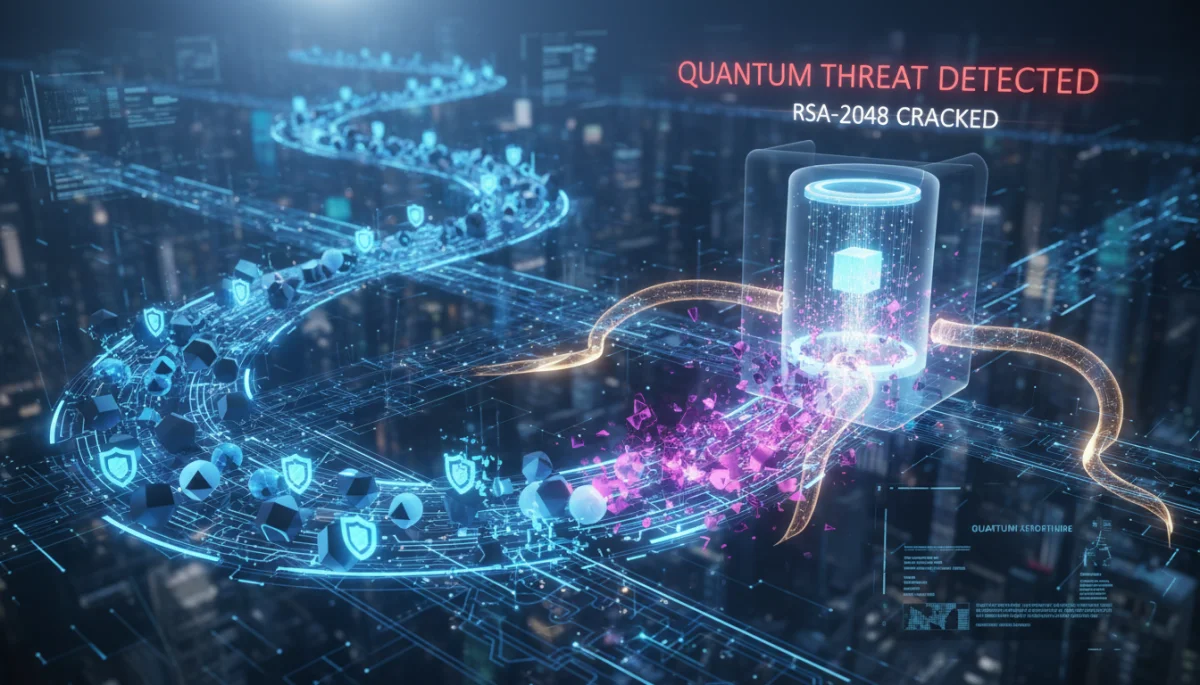
The vulnerability extends to the entire chain of trust, including digital certificates, secure boot processes, and VPNs. If the underlying cryptographic primitives are compromised, the integrity and confidentiality of virtually all digital interactions are at stake. This necessitates a comprehensive re-evaluation of current security postures and a strategic shift towards quantum-resistant solutions.
Post-Quantum Cryptography (PQC): The Shield Against Quantum Threats
Recognizing the impending threat, cryptographers worldwide are actively developing and standardizing Post-Quantum Cryptography (PQC) – cryptographic algorithms designed to be secure against both classical and quantum computers. PQC is the cornerstone of our defense against the quantum era, aiming to replace vulnerable algorithms before quantum computers become powerful enough to break them.
The National Institute of Standards and Technology (NIST) has been leading a multi-year standardization process for PQC algorithms. This rigorous process involves evaluating various candidates for their security, performance, and practicality, ensuring that the chosen algorithms can withstand future quantum attacks while remaining efficient for widespread adoption.
Key Categories of PQC Algorithms
PQC algorithms fall into several distinct categories, each based on different mathematical problems believed to be hard for quantum computers.
- Lattice-based Cryptography: Relies on the difficulty of solving certain problems in high-dimensional lattices.
- Code-based Cryptography: Based on error-correcting codes, such as the McEliece cryptosystem.
- Multivariate Polynomial Cryptography: Uses systems of multivariate polynomial equations over finite fields.
- Hash-based Signatures: Built on cryptographic hash functions, offering robust digital signatures.
The goal of PQC is not to use quantum mechanics for encryption but to design classical algorithms that are resistant to quantum attacks. This is a critical distinction, as it means PQC can be implemented on existing classical computing infrastructure, facilitating a smoother transition. The challenge lies in ensuring these new algorithms are truly secure, performant, and interoperable across diverse systems.
The development and deployment of PQC are complex undertakings, requiring significant research, testing, and collaboration across industry, academia, and government. The timeline for full standardization and widespread adoption is ambitious, but the urgency of the quantum threat demands a concerted and rapid effort to secure our digital future.
The 2026 Horizon: A Critical Juncture for Data Security
The year 2026 is often cited as a critical milestone in the quantum computing timeline, not necessarily as the year quantum computers will break all encryption, but as a point where the threat becomes undeniable and the need for transition becomes paramount. By this time, many experts predict that quantum hardware will have advanced sufficiently to demonstrate real-world cryptographic relevance, prompting a widespread urgency to adopt PQC.
Organizations that have not begun their quantum-readiness assessments by 2026 risk significant exposure. The “Harvest Now, Decrypt Later” threat is particularly concerning: adversaries could be collecting encrypted data today, intending to decrypt it once powerful quantum computers are available. This means data with long-term confidentiality requirements, such as medical records, government secrets, or intellectual property, are already at risk.
Strategic Steps for Organizations by 2026
To navigate this critical period, organizations need to implement a multi-faceted strategy.
- Inventory Cryptographic Assets: Identify all systems, applications, and data protected by cryptography.
- Assess Quantum Vulnerability: Determine which cryptographic algorithms are susceptible to quantum attacks.
- Develop a Migration Roadmap: Plan the transition to PQC, prioritizing critical systems and long-lived data.
- Engage with PQC Standards: Stay informed about NIST’s standardization process and emerging PQC solutions.
The move to PQC is not a simple patch; it requires a fundamental overhaul of cryptographic infrastructure. This includes updating hardware, software, and protocols across an entire digital ecosystem. The complexity and scale of this transition demand early planning and resource allocation to avoid a chaotic and insecure future.
Furthermore, the global nature of digital communications means that international cooperation and standardized approaches to PQC are essential. A fragmented approach would create new vulnerabilities and hinder the secure exchange of information across borders. The 2026 horizon serves as a powerful reminder that proactive preparation is the only viable path forward.
Preparing Your Data for the Quantum Future: A Practical Guide
Given the looming quantum threat, individuals and organizations must start preparing their data security strategies now. Waiting until quantum computers are fully operational will be too late, as the window for secure migration will have closed. Proactive measures are key to safeguarding sensitive information against future decryption.
For individuals, this means being aware of the types of data that might have long-term value to adversaries and ensuring that any particularly sensitive information is secured with the strongest available methods. While direct implementation of PQC is largely an enterprise task, understanding the landscape is crucial.
Organizational Quantum Readiness Steps
Organizations should undertake a structured approach to quantum readiness.
- Cryptographic Agility: Design systems to be flexible and easily upgradeable to new cryptographic algorithms.
- Hybrid Mode Deployment: Initially, deploy PQC algorithms alongside current classical algorithms for a “belt-and-suspenders” approach.
- Employee Training: Educate IT staff and developers on PQC principles and implementation best practices.
- Supply Chain Security: Work with vendors to ensure their products and services will be quantum-safe.
The transition to PQC will be a complex, multi-year process. It requires not just technical changes but also organizational commitment and strategic foresight. Companies need to allocate budgets, assign dedicated teams, and integrate quantum readiness into their overall cybersecurity posture. This includes considering the cryptographic implications of all new projects and technologies.
Moreover, the shift isn’t just about replacing algorithms; it’s about understanding the entire cryptographic attack surface. This includes key management practices, random number generation, and protocol design. A holistic approach will be necessary to ensure that the move to PQC genuinely enhances security rather than introducing new vulnerabilities.
Beyond Encryption: Quantum-Safe Digital Signatures and Key Exchange
While much of the focus is on encrypting data against quantum attacks, other critical cryptographic functions, such as digital signatures and key exchange mechanisms, are equally vulnerable and require quantum-safe alternatives. These elements are fundamental to verifying identity, ensuring data integrity, and establishing secure communication channels.
Digital signatures are used to authenticate the sender of a message and ensure that the message has not been tampered with. Key exchange protocols allow two parties to establish a shared secret key over an insecure channel. Both are vital for the functioning of the internet and secure commerce.
Importance of Quantum-Safe Signatures
Quantum-safe digital signatures are crucial for maintaining trust in digital transactions and communications.
- Software Updates: Ensures that software downloaded is legitimate and untampered.
- Financial Transactions: Authenticates parties in banking and online payments.
- Legal Documents: Provides non-repudiation for digital contracts and agreements.
Without quantum-safe digital signatures, the integrity of almost all digital processes could be undermined. An attacker with a quantum computer could forge signatures, impersonate legitimate entities, and inject malicious code, leading to widespread chaos and distrust in digital systems. The transition to PQC must therefore encompass these critical functions.
Similarly, quantum-safe key exchange protocols are necessary to establish secure communication sessions. If an attacker can break the key exchange, they can then decrypt all subsequent communications, even if the data itself is encrypted with a strong symmetric cipher. This highlights the interconnectedness of cryptographic security and the need for a comprehensive quantum-safe strategy that addresses all layers of protection. The future of secure digital interaction hinges on the successful and timely implementation of these advanced cryptographic solutions.
| Key Point | Brief Description |
|---|---|
| Quantum Threat | Quantum computers can break current public-key encryption (RSA, ECC) using Shor’s algorithm. |
| Post-Quantum Cryptography (PQC) | New cryptographic algorithms resistant to both classical and quantum attacks, under NIST standardization. |
| 2026 Critical Juncture | Expected timeframe when quantum hardware poses a significant threat, demanding urgent PQC adoption. |
| Data Preparation | Organizations must inventory assets, assess vulnerabilities, and plan PQC migration proactively. |
Frequently Asked Questions About Quantum Encryption
The primary threat is the ability of quantum computers, particularly through Shor’s algorithm, to efficiently break widely used public-key encryption schemes like RSA and ECC, which protect most of our digital communications and data today.
PQC refers to cryptographic algorithms designed to be secure against attacks from both classical and quantum computers. These are classical algorithms based on mathematical problems that even quantum computers are expected to find difficult to solve.
2026 is seen as a critical juncture because experts anticipate that quantum hardware will have advanced enough to pose a tangible threat to current encryption, necessitating urgent and widespread adoption of quantum-resistant solutions.
Yes, data encrypted today with vulnerable algorithms could be stored by adversaries (the “Harvest Now, Decrypt Later” threat) and decrypted in the future once sufficiently powerful quantum computers become available. This is especially true for long-lived sensitive data.
Organizations should inventory cryptographic assets, assess quantum vulnerabilities, develop a PQC migration roadmap, and engage with NIST’s standardization efforts. Adopting cryptographic agility and hybrid deployment strategies are also crucial steps.
Conclusion
The impending reality of quantum computing presents an unprecedented challenge to the very foundations of digital security. As we approach the 2026 horizon, the theoretical threat of quantum attacks on current encryption is rapidly solidifying into a tangible concern. The development and widespread adoption of Post-Quantum Cryptography (PQC) are not merely academic exercises but urgent necessities to safeguard our digital lives. Organizations and individuals must proactively assess their vulnerabilities, plan for the transition, and embrace quantum-safe solutions to ensure the integrity and confidentiality of their data in the quantum era. The future of secure information exchange depends on our collective ability to adapt and innovate in the face of this transformative technological shift.