Swarm Robotics: US Applications for Enhanced Efficiency
Anúncios
Swarm robotics, utilizing multiple small, cooperative robots, is poised to significantly enhance efficiency in US agriculture through precision farming and revolutionize exploration by tackling complex, hazardous environments by late 2026.
Anúncios
Imagine a future where vast fields are meticulously managed by countless tiny, autonomous agents, or where hazardous environments are explored without risking human lives. This vision is rapidly becoming a reality with swarm robotics: US applications for enhanced efficiency in agriculture and exploration by late 2026 are set to redefine productivity and safety across critical sectors. How will these collaborative robot systems transform our daily lives and our reach into the unknown?
The foundational principles of swarm robotics
Swarm robotics represents a fascinating branch of artificial intelligence and robotics, drawing inspiration from natural systems like ant colonies and bird flocks. Instead of relying on a single, complex, and expensive robot, swarm robotics employs numerous simpler, less costly robots that work together to achieve a common goal. This decentralized approach offers remarkable resilience and scalability, making it ideal for tasks that are too complex or dangerous for individual machines or humans.
At its core, swarm robotics operates on principles of local interaction and emergent behavior. Each robot follows a set of simple rules, interacting only with its immediate neighbors or local environment. From these basic interactions, complex and intelligent global behaviors emerge, allowing the swarm to adapt to dynamic conditions and accomplish sophisticated tasks. This collective intelligence is what makes swarm systems so powerful and versatile.
Key characteristics of swarm intelligence
Understanding swarm intelligence means grasping its core attributes that differentiate it from traditional robotics. These characteristics are fundamental to its effectiveness and future potential.
- Decentralization: No single robot acts as a leader; control is distributed among all members, preventing single points of failure.
- Scalability: The system’s performance can be easily adjusted by adding or removing robots, without needing to redesign the entire system.
- Robustness: The failure of a few individual robots does not cripple the entire mission, as others can compensate.
- Flexibility: Swarms can adapt to changing environments and unexpected obstacles more readily than monolithic systems.
These principles allow swarm robotics to tackle challenges that would be insurmountable for individual robots. The ability to collectively sense, process information, and act in concert unlocks new possibilities for automation and problem-solving across various industries. This foundational understanding is crucial for appreciating the transformative impact these systems will have in the United States.
Transforming US agriculture with robotic swarms
The agricultural sector in the United States faces increasing demands for efficiency, sustainability, and precision. Swarm robotics offers a compelling solution to many of these challenges, promising a revolution in how crops are managed, harvested, and monitored. By late 2026, we anticipate seeing widespread adoption of these technologies, fundamentally altering farming practices.
Anúncios
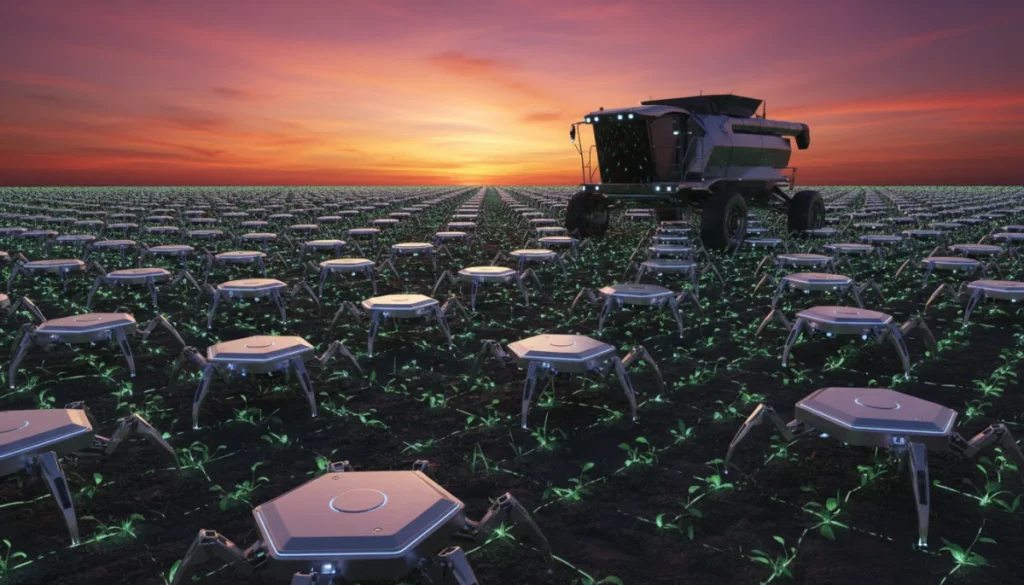
Precision agriculture is where swarm robotics truly shines. Instead of broad-scale application of resources like water and pesticides, swarms of small robots can meticulously analyze individual plants or small plots. This allows for highly targeted interventions, reducing waste, minimizing environmental impact, and ultimately increasing yields. The economic benefits for farmers are substantial, leading to more sustainable and profitable operations.
Applications in crop monitoring and pest control
One of the most immediate applications of swarm robotics in agriculture is in detailed crop monitoring. Tiny robots equipped with advanced sensors can navigate fields, collecting real-time data on plant health, soil conditions, and moisture levels. This granular data provides farmers with unprecedented insights, enabling proactive decision-making.
- Individual plant health assessment: Robots can identify stressed plants or early signs of disease, allowing for immediate, localized treatment.
- Targeted pest management: Instead of blanket spraying, swarms can detect pest infestations and apply pesticides only where needed, reducing chemical use significantly.
- Automated pollination: Miniature flying robots could assist in pollinating crops, especially in areas where natural pollinators are scarce.
- Weed detection and removal: Swarms can identify and precisely remove weeds, reducing the need for herbicides and manual labor.
The collective intelligence of these swarms allows them to cover vast areas efficiently, sharing data and coordinating their efforts to ensure comprehensive coverage. This capability translates directly into higher productivity and healthier crops, positioning US agriculture at the forefront of technological innovation.
Swarm robotics in US exploration: pushing boundaries
Beyond Earth’s fertile fields, swarm robotics is poised to redefine the limits of exploration, particularly in environments too dangerous, remote, or vast for human-crewed missions. From deep-sea trenches to the surface of distant planets, these autonomous collectives offer a resilient and adaptable solution for gathering critical data and performing complex tasks. The United States, with its leading space agencies and oceanographic institutes, is at the forefront of developing these groundbreaking applications.
The inherent redundancy and distributed intelligence of robotic swarms make them ideal for missions where failure is not an option. A single robot might succumb to extreme conditions, but the mission continues as the collective adapts and reconfigures. This robustness is invaluable in environments where repair or recovery is impossible, such as on Mars or under kilometers of ocean water. By late 2026, expect to see significant strides in autonomous exploration capabilities powered by these intelligent swarms.
Deep-sea exploration and hazardous environment mapping
Exploring the ocean’s abyssal plains and hydrothermal vents presents immense challenges due to extreme pressure, cold, and darkness. Swarms of underwater robots, or Autonomous Underwater Vehicles (AUVs), can work collaboratively to map vast areas, identify new species, and monitor geological activity.
- Comprehensive seafloor mapping: Multiple AUVs can survey large sections of the ocean floor much faster than a single vessel, creating highly detailed 3D maps.
- Monitoring marine ecosystems: Swarms can track marine life migration patterns, assess ecosystem health, and detect pollution sources over wide areas.
- Inspecting underwater infrastructure: Robots can collectively inspect pipelines, oil rigs, and communication cables for damage, ensuring critical infrastructure integrity.
Similarly, in hazardous terrestrial environments like collapsed mines or nuclear disaster sites, swarm robots can provide vital reconnaissance without endangering human rescuers. Their small size and agility allow them to navigate tight spaces and unstable terrains, providing real-time data and even performing minor repairs or data retrieval. This capability is crucial for disaster response and recovery efforts.
The role of AI and machine learning in swarm coordination
The sophistication and effectiveness of swarm robotics are inextricably linked to advancements in artificial intelligence (AI) and machine learning (ML). These computational powerhouses provide the brains behind the collective, enabling robots to learn, adapt, and coordinate their actions in increasingly complex ways. Without cutting-edge AI, swarm robotics would remain a collection of simple machines rather than a truly intelligent system.
AI algorithms allow individual robots to interpret sensor data, make local decisions, and communicate effectively with their peers. Machine learning, particularly reinforcement learning, enables the entire swarm to improve its performance over time by learning from past experiences and adapting its strategies. This continuous learning process is vital for tackling unforeseen challenges in dynamic environments, ensuring that swarm systems become more efficient and reliable with every mission.
Advanced algorithms for collective intelligence
The development of sophisticated algorithms is key to unlocking the full potential of swarm intelligence. These algorithms dictate how individual robots perceive, decide, and act within the collective.
- Distributed consensus algorithms: Enable robots to agree on shared goals or environmental states without a central controller.
- Behavioral synchronization: Algorithms that allow robots to coordinate movements and actions, like synchronized searching or object manipulation.
- Self-organization and self-healing: Mechanisms that allow swarms to form optimal configurations and recover from individual robot failures autonomously.
- Predictive analytics: AI models that forecast environmental changes or potential obstacles, allowing the swarm to prepare and adapt proactively.
The synergy between swarm robotics and AI/ML is a critical driver for innovation. As AI models become more powerful and efficient, the capabilities of robotic swarms will expand exponentially, leading to even more remarkable applications in both agriculture and exploration. The ongoing research in these areas in the US is vital for maintaining a competitive edge.
Challenges and ethical considerations
While the promise of swarm robotics is immense, its widespread adoption is not without significant challenges and ethical considerations. Addressing these issues proactively is crucial for ensuring responsible development and public acceptance. Technical hurdles, regulatory frameworks, and societal impacts all need careful navigation as these technologies mature and integrate into our daily lives.
One primary technical challenge lies in ensuring robust communication and coordination in highly dynamic and potentially hostile environments. Maintaining connectivity among hundreds or thousands of robots, especially in remote or signal-denied areas, requires advanced networking solutions. Furthermore, the energy efficiency of individual robots and the entire swarm is a constant design constraint, particularly for long-duration missions.
Navigating the ethical landscape
The ethical implications of autonomous swarm systems are complex and multifaceted. As robots become more intelligent and capable of independent decision-making, questions arise about accountability and control.
- Accountability in failure: Who is responsible when a swarm system makes an error or causes harm? Defining liability for autonomous agents is a new legal frontier.
- Data privacy and security: Swarms collect vast amounts of data. Ensuring this data is protected from misuse and cyber threats is paramount.
- Human-robot interaction: How will humans interact with and supervise large swarms of robots? Designing intuitive and safe interfaces is essential.
- Job displacement: The increased automation brought by swarm robotics could impact employment in certain sectors, necessitating thoughtful policy responses and retraining programs.
Addressing these challenges requires a collaborative effort from engineers, policymakers, ethicists, and the public. Open dialogue and transparent development practices will be key to building trust and ensuring that swarm robotics serves humanity’s best interests while mitigating potential risks.
The future outlook: beyond 2026 for swarm robotics
Looking beyond late 2026, the trajectory for swarm robotics in the US is one of accelerating innovation and expanding application. The foundations laid in agriculture and exploration will undoubtedly pave the way for entirely new uses, further integrating these intelligent collectives into the fabric of society. The next decade promises to be transformative, with swarm systems becoming increasingly sophisticated, autonomous, and ubiquitous.
We can anticipate a future where swarm robotics moves from specialized industrial and scientific applications into more common societal roles. Imagine swarms of tiny robots maintaining urban infrastructure, assisting in complex manufacturing processes, or even playing a role in personalized healthcare. The scalability and adaptability of these systems make them ideal candidates for solving a myriad of problems that currently seem intractable.

Emerging applications and research directions
The research community is continually pushing the boundaries of what swarm robotics can achieve. Several exciting areas are currently under investigation that could lead to revolutionary applications.
- Swarm manufacturing: Robots capable of self-assembling complex structures or fabricating materials at a microscopic level.
- Medical micro-robotics: Swarms of microscopic robots designed for targeted drug delivery, minimally invasive surgery, or internal diagnostics within the human body.
- Environmental remediation: Autonomous swarms designed to clean up pollution, monitor air quality, or restore damaged ecosystems.
- Logistics and delivery: Highly efficient and flexible swarm systems for last-mile delivery or complex warehouse management.
The ongoing investment in STEM education and research in the United States will be critical in nurturing the talent required to bring these future visions to fruition. As computing power increases and AI algorithms become more refined, the potential for swarm robotics to address some of humanity’s most pressing challenges will only grow, solidifying its role as a cornerstone technology of the 21st century.
| Key Application Area | Impact by Late 2026 |
|---|---|
| Agriculture | Enhanced precision farming, targeted pest control, increased crop yields, and reduced resource consumption. |
| Space Exploration | Robust planetary surface mapping, sample collection in hazardous zones, and long-duration mission resilience. |
| Deep-Sea Exploration | Comprehensive seafloor mapping, marine ecosystem monitoring, and infrastructure inspection in extreme conditions. |
| AI & Coordination | Advanced algorithms driving collective intelligence, self-organization, and adaptive behavior in complex tasks. |
Frequently asked questions about swarm robotics
Swarm robotics is an approach to robotics that uses multiple simple, cooperative robots working together as a collective to achieve complex tasks. Inspired by natural swarms like ant colonies, these systems rely on decentralized control and local interactions to exhibit emergent intelligent behavior.
By late 2026, swarm robotics will enhance precision agriculture in the US through detailed crop monitoring, targeted pest control, and efficient resource management. This will lead to increased yields, reduced chemical use, and more sustainable farming practices across the nation.
In exploration, swarm robotics is crucial for tasks in hazardous or inaccessible environments. This includes deep-sea mapping, planetary surface exploration (e.g., Mars), and reconnaissance in disaster zones, offering robust data collection without risking human lives due to their collective resilience.
Artificial intelligence and machine learning are fundamental to swarm robotics, enabling individual robots to make decisions, coordinate actions, and adapt to changing environments. AI algorithms facilitate collective intelligence, allowing swarms to learn from experience and improve their performance over time.
Ethical concerns include accountability in case of system failure, data privacy and security of collected information, the potential for job displacement, and establishing clear human oversight. These issues require careful consideration and robust regulatory frameworks for responsible development and deployment.
Conclusion
The emergence of swarm robotics represents a pivotal technological shift, promising unparalleled efficiencies and capabilities across diverse sectors in the United States. From revolutionizing agricultural practices with precision farming to pushing the boundaries of exploration in the most extreme environments, these collaborative robotic systems are set to redefine what’s possible by late 2026. While challenges and ethical considerations remain, the ongoing advancements in AI and robotics underscore a future where intelligent swarms play an increasingly vital role in our progress and prosperity.