Wi-Fi 7: Transforming Home Networks by 2026

Anúncios
Wi-Fi 7, also known as 802.11be, is set to revolutionize home networks by 2026, delivering unparalleled speeds, ultra-low latency, and robust capacity for the next generation of connected devices and immersive experiences.
Anúncios
The digital landscape of our homes is constantly evolving, demanding more from our wireless connections than ever before. If you’re wondering how the next leap in wireless technology will impact your daily life, then Understanding Wi-Fi 7: How This New Standard Will Transform Your Home Network in 2026 is crucial. This new standard promises to redefine what’s possible, offering a glimpse into a future where buffering and lag become relics of the past.
The Dawn of Wi-Fi 7: What is 802.11be?
Wi-Fi 7, officially known as 802.11be or Extremely High Throughput (EHT), represents the next major evolution in wireless communication. Building upon the foundations laid by Wi-Fi 6 and Wi-Fi 6E, this new standard is engineered to meet the escalating demands of modern digital lifestyles. From ultra-high-definition streaming to virtual reality and augmented reality applications, Wi-Fi 7 is designed to handle it all with unprecedented efficiency and speed.
The development of Wi-Fi 7 has been driven by the need for more robust and faster wireless networks. As more devices connect to our home networks, the strain on existing Wi-Fi standards becomes apparent. Wi-Fi 7 addresses these challenges head-on, introducing a suite of innovations that will significantly enhance performance.
Key Objectives of Wi-Fi 7
The primary goals behind the creation of Wi-Fi 7 are straightforward: increase throughput, reduce latency, and improve network capacity. These objectives are critical for supporting emerging technologies and ensuring a seamless user experience across a multitude of devices.
- Increased Throughput: Wi-Fi 7 aims to deliver multi-gigabit speeds, making it possible to download large files and stream 8K video effortlessly.
- Reduced Latency: Essential for real-time applications like online gaming, VR, and industrial automation, lower latency ensures instantaneous responses.
- Enhanced Capacity: With more devices per household, Wi-Fi 7 can manage a greater number of simultaneous connections without performance degradation.
In essence, Wi-Fi 7 is not just about faster speeds; it’s about creating a more reliable, efficient, and responsive wireless environment that can adapt to the future of connectivity. This foundational understanding is vital to appreciate the transformative potential it holds for home networks by 2026.
Unprecedented Speed and Capacity: The Core of Wi-Fi 7
The most immediately noticeable benefit of Wi-Fi 7 will be its dramatic increase in speed and capacity. While Wi-Fi 6 and 6E offered significant improvements, Wi-Fi 7 takes this to an entirely new level, pushing the boundaries of what was previously thought possible for wireless networks. These advancements are critical for supporting the growing number of data-intensive applications and devices in our homes.
Imagine downloading a full-length 4K movie in seconds, or experiencing completely lag-free virtual reality environments. This is the promise of Wi-Fi 7’s enhanced throughput. It’s not just about raw speed, but also about how efficiently this speed is delivered to multiple devices simultaneously, ensuring that every connected gadget performs optimally without competing for bandwidth.
Anúncios
Boosting Throughput with Wider Channels and Higher Modulation
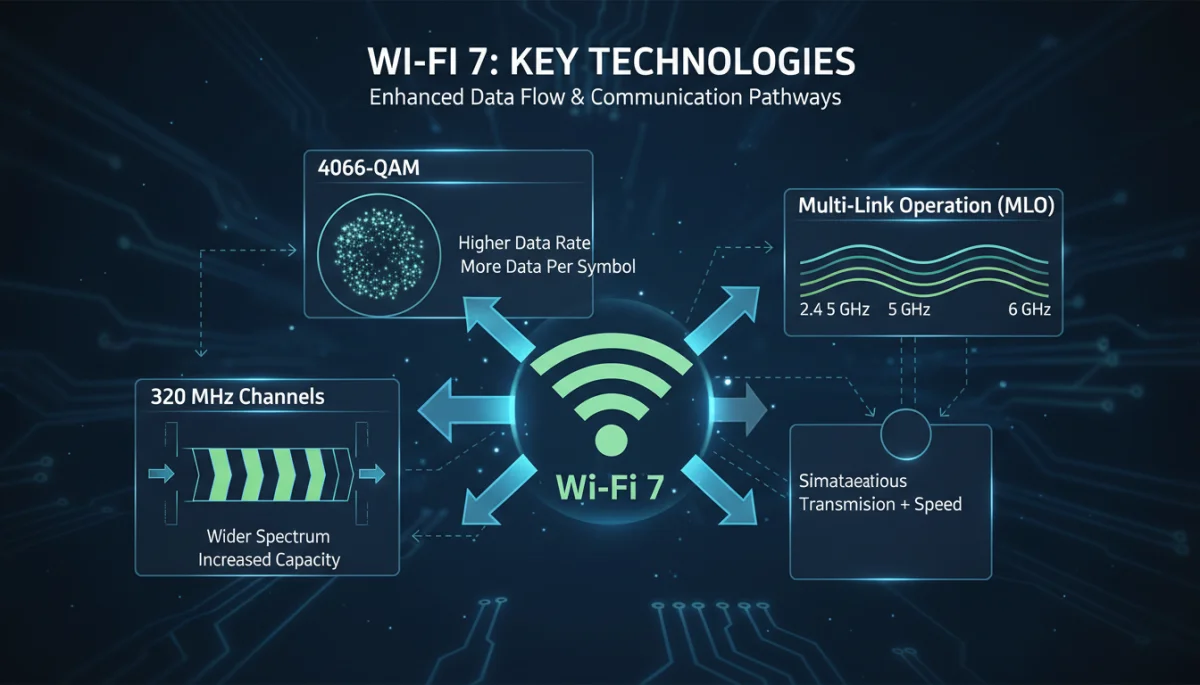
Wi-Fi 7 achieves its incredible speeds through several key technological innovations. One of the most significant is the ability to utilize wider channels, specifically up to 320 MHz in the 6 GHz band. This is double the channel width available in Wi-Fi 6E, effectively creating superhighways for data transmission.
- 320 MHz Channels: These wider channels allow for a much larger volume of data to be transmitted at once, dramatically increasing potential speeds.
- 4096-QAM (Quadrature Amplitude Modulation): Wi-Fi 7 introduces 4096-QAM, a higher-order modulation scheme that packs more data into each signal. This is a significant leap from Wi-Fi 6’s 1024-QAM, translating directly into higher data rates.
These combined features mean that devices compatible with Wi-Fi 7 will experience theoretical peak speeds that could exceed 30 Gbps, far surpassing the capabilities of current Wi-Fi standards. This immense bandwidth will be crucial for the next generation of high-resolution content, cloud gaming, and advanced smart home ecosystems.
Furthermore, Wi-Fi 7’s design focuses on maximizing the use of available spectrum across all three bands: 2.4 GHz, 5 GHz, and 6 GHz. By intelligently managing these bands, it ensures that devices are always connected to the most efficient pathway, minimizing congestion and optimizing performance for every application. This intelligent allocation of resources is what allows Wi-Fi 7 to handle an unprecedented number of connected devices without compromising on speed or reliability. The result is a home network that feels consistently fast and responsive, regardless of how many devices are active or what demanding tasks they are performing.
Multi-Link Operation (MLO): The Game Changer
One of the most revolutionary features introduced with Wi-Fi 7 is Multi-Link Operation (MLO). This technology fundamentally changes how devices connect to a Wi-Fi network, moving beyond the traditional single-band connection model. MLO allows devices to simultaneously send and receive data across different frequency bands and channels, effectively combining their bandwidth for superior performance and reliability.
Think of it like this: instead of having a single lane for traffic, MLO opens up multiple lanes, allowing data to flow more freely and efficiently. This is particularly beneficial in congested environments or for applications that require extremely low latency and high throughput. MLO offers a dynamic and adaptive approach to wireless communication, ensuring that your devices always have the best possible connection.
How MLO Enhances Your Network
MLO operates in two primary modes: Multi-Link Aggregation and Multi-Link Redundancy. Both modes offer distinct advantages that contribute to a more robust and efficient home network.
- Multi-Link Aggregation: In this mode, multiple links across different bands (e.g., 5 GHz and 6 GHz) are combined to increase the overall bandwidth available to a device. This means a single device can achieve much higher speeds than it could on a single band alone.
- Multi-Link Redundancy: This mode provides enhanced reliability by sending the same data over multiple links simultaneously. If one link experiences interference or drops, the data can still arrive via another link, ensuring an uninterrupted connection. This is critical for mission-critical applications and real-time streaming.
The ability to dynamically switch or combine links based on network conditions means that Wi-Fi 7 devices will experience fewer drops, less interference, and consistently higher performance. This adaptive nature of MLO is a significant leap forward, making home networks more resilient and capable of handling the demands of future technologies. By 2026, MLO will be a cornerstone of seamless connectivity, providing a noticeable difference in how we interact with our digital world.
Lower Latency and Enhanced Reliability for Critical Applications
Beyond sheer speed, Wi-Fi 7 places a strong emphasis on reducing latency and improving the overall reliability of wireless connections. These aspects are becoming increasingly critical for a wide range of applications, from competitive online gaming and virtual reality to smart home automation and real-time video conferencing. High latency can lead to frustrating delays and a degraded user experience, which Wi-Fi 7 aims to eliminate.
The architectural improvements in Wi-Fi 7 are designed to minimize the time it takes for data to travel from your device to the router and back. This almost instantaneous communication is not just a luxury; it’s a necessity for applications where even a few milliseconds of delay can significantly impact performance or safety. By focusing on these core elements, Wi-Fi 7 ensures that your home network is not only fast but also incredibly responsive and dependable.
Features Driving Low Latency
Several key technologies within Wi-Fi 7 contribute to its superior latency performance. These features work in conjunction to streamline data flow and reduce bottlenecks that typically cause delays in older Wi-Fi standards.
- Preamble Puncturing: This innovative technique allows Wi-Fi 7 devices to utilize wider channels even when some parts of the channel are occupied by interference. Instead of waiting for the entire channel to clear, the Wi-Fi 7 system can ‘puncture’ around the interference, using the remaining clear portions of the channel. This maximizes channel utilization and reduces waiting times.
- Refined OFDMA (Orthogonal Frequency-Division Multiple Access): Building on Wi-Fi 6, Wi-Fi 7 further optimizes OFDMA, allowing more efficient allocation of bandwidth to multiple users simultaneously. This reduces contention and ensures that each device receives its data quickly and without delays.
The combination of these features, alongside Multi-Link Operation, creates a network environment where latency is significantly reduced, and reliability is boosted. For homeowners, this means smoother gaming, crystal-clear video calls, and responsive smart home devices without any noticeable lag. By 2026, Wi-Fi 7 will be the standard for a truly real-time digital experience, making frustrating delays a thing of the past.
The 6 GHz Band: Unleashing Wi-Fi 7’s Full Potential
The introduction and expansion of the 6 GHz frequency band are pivotal to Wi-Fi 7’s ability to deliver on its promises. While Wi-Fi 6E initiated the use of this band, Wi-Fi 7 fully leverages its capabilities to provide unprecedented performance. The 6 GHz band is often referred to as the ‘superhighway’ for Wi-Fi, primarily because it is much less congested than the traditional 2.4 GHz and 5 GHz bands.
Unlike its predecessors, the 6 GHz band offers a vast, contiguous block of spectrum, free from the legacy interference that plagues older bands. This clean slate allows Wi-Fi 7 to deploy its widest channels and highest modulation schemes without competition from older Wi-Fi devices or other wireless technologies. The result is a network that can achieve its maximum theoretical speeds and maintain consistent performance, even in dense environments.
Advantages of the 6 GHz Band for Wi-Fi 7
The exclusive nature and wider channels of the 6 GHz band provide several distinct advantages that are crucial for Wi-Fi 7’s enhanced capabilities.
- Reduced Interference: Being a relatively new band for Wi-Fi, the 6 GHz spectrum is largely free from the clutter of older Wi-Fi devices, Bluetooth, and other wireless technologies that operate in the 2.4 GHz and 5 GHz bands. This translates to cleaner signals and more reliable connections.
- Wider Channels: The 6 GHz band provides enough contiguous spectrum to support the 320 MHz channels that are fundamental to Wi-Fi 7’s multi-gigabit speeds. These wide channels are impractical in the more fragmented 2.4 GHz and 5 GHz bands.
- Increased Capacity: With more available channels and less interference, the 6 GHz band significantly increases the overall capacity of the Wi-Fi network, allowing a greater number of devices to operate simultaneously at high speeds without performance degradation.
By 2026, as more devices and routers become Wi-Fi 7 compatible, the 6 GHz band will become the backbone of high-performance home networks. It will enable seamless streaming of 8K content, immersive VR experiences, and rapid data transfers, transforming how we interact with our digital world. The clean and expansive nature of the 6 GHz band is truly what unlocks the full potential of Wi-Fi 7, making it a game-changer for future connectivity.
Impact on Smart Homes and Emerging Technologies by 2026
The arrival of Wi-Fi 7 will have a profound impact on the evolution of smart homes and the adoption of emerging technologies by 2026. As our living spaces become increasingly interconnected, the demands on our home networks multiply. Wi-Fi 7 is not just an incremental upgrade; it’s a foundational shift that will enable a new generation of smart devices and immersive experiences that were previously limited by network constraints.
Consider the proliferation of smart home devices, from intelligent thermostats and lighting systems to security cameras and robotic vacuums. Each of these devices requires a stable and often low-latency connection. Add to this the growing trend of high-bandwidth applications like 8K video streaming, cloud gaming, and untethered virtual reality, and it becomes clear that current Wi-Fi standards are quickly reaching their limits. Wi-Fi 7 is designed to be the robust backbone for this increasingly complex digital ecosystem.
Enabling the Future of Connectivity
Wi-Fi 7’s enhanced capabilities will unlock new possibilities for smart homes and emerging technologies, making them more responsive, reliable, and integrated than ever before.
- Enhanced Smart Home Automation: With lower latency and higher capacity, smart home devices will communicate more seamlessly. Imagine instant responses from voice assistants, perfectly synchronized smart lighting, and real-time streaming from multiple high-definition security cameras without a hitch.
- Immersive VR/AR Experiences: Untethered virtual and augmented reality applications require immense bandwidth and ultra-low latency to prevent motion sickness and ensure a realistic experience. Wi-Fi 7’s MLO and high throughput will make truly immersive, wire-free VR/AR a reality in the home.
- Cloud Gaming and 8K Streaming: Cloud gaming relies heavily on a stable, low-latency connection to deliver a console-like experience. Similarly, 8K video streaming demands significant bandwidth. Wi-Fi 7 will provide the necessary infrastructure for these services to thrive, becoming commonplace in homes by 2026.
Ultimately, Wi-Fi 7 will transform the smart home from a collection of connected gadgets into a truly intelligent and responsive environment. Its ability to handle a massive number of devices with high-speed, low-latency connections will be the catalyst for widespread adoption of advanced smart home technologies and the seamless integration of emerging digital experiences into our daily lives. The future of home connectivity is bright, and Wi-Fi 7 is leading the way.
Preparing Your Home Network for Wi-Fi 7 in 2026
As 2026 approaches, many homeowners will naturally wonder how to prepare their current setup for the transition to Wi-Fi 7. The good news is that while a full upgrade will eventually be necessary to experience all the benefits, there are steps you can take now, and considerations for future purchases, to ensure a smooth transition. Understanding these steps will help you maximize your investment and fully embrace the next generation of wireless technology.
The shift to Wi-Fi 7 will involve more than just a new router; it will also require compatible client devices to take full advantage of the new standard’s features. However, the ecosystem is developing rapidly, and by being informed, you can make strategic decisions that will future-proof your home network. It’s about smart planning to avoid being left behind as the digital landscape evolves.
Key Steps for a Smooth Transition
Preparing for Wi-Fi 7 involves a combination of hardware considerations and understanding compatibility. Here are some practical steps and insights:
- Upgrade Your Router: The most critical component will be a Wi-Fi 7 compatible router. These devices will begin to become more widely available and affordable as 2026 approaches. Look for routers that explicitly state 802.11be or Wi-Fi 7 compatibility.
- Update Client Devices: To fully benefit from Wi-Fi 7, your devices (smartphones, laptops, smart TVs, VR headsets) will also need to support the standard. While older devices will still connect, they won’t achieve Wi-Fi 7 speeds and features. Consider Wi-Fi 7 compatibility when purchasing new electronics.
- Consider Wired Backhaul: For optimal performance, especially in larger homes, consider upgrading your Ethernet infrastructure to support multi-gigabit speeds for wired backhaul connections between mesh nodes or to high-demand devices.
While Wi-Fi 7 is designed to be backward compatible with older Wi-Fi standards, you will only unlock its full potential with a complete ecosystem of Wi-Fi 7 enabled devices. By planning ahead and making informed purchasing decisions, you can ensure that your home network is ready to embrace the transformative power of Wi-Fi 7 by 2026, providing unparalleled speed, reliability, and responsiveness for years to come.
| Key Feature | Description and Benefit |
|---|---|
| Multi-Link Operation (MLO) | Allows devices to use multiple frequency bands simultaneously, enhancing speed and reliability significantly. |
| 320 MHz Channels | Doubles channel width in the 6 GHz band for vastly increased data throughput and faster speeds. |
| 4096-QAM | Higher data density per signal, leading to theoretical peak speeds exceeding 30 Gbps. |
| Preamble Puncturing | Improves channel utilization by allowing data transmission even with partial interference, reducing latency. |
Frequently Asked Questions About Wi-Fi 7
Wi-Fi 7 significantly surpasses Wi-Fi 6E by introducing Multi-Link Operation (MLO), wider 320 MHz channels, and 4096-QAM modulation. These advancements lead to much higher theoretical speeds (up to 30 Gbps), lower latency, and improved network efficiency, especially for high-bandwidth and real-time applications.
Yes, Wi-Fi 7 is designed to be backward compatible, meaning your older Wi-Fi 6, Wi-Fi 5, and earlier devices will still connect to a Wi-Fi 7 router. However, to experience the full benefits of Wi-Fi 7, such as multi-gigabit speeds and ultra-low latency, you will need Wi-Fi 7 compatible client devices.
Wi-Fi 7’s ultra-low latency and Multi-Link Operation (MLO) are game-changers for online gaming and VR. MLO ensures a more stable and faster connection by utilizing multiple bands, minimizing lag and jitter. This results in smoother gameplay, more responsive controls, and a more immersive, wire-free virtual reality experience.
While some early Wi-Fi 7 products are already emerging, widespread adoption and availability of routers and compatible client devices are expected to ramp up significantly by 2025, with a strong market presence projected for 2026. This timeline allows for standardization and product maturation.
The 6 GHz band is crucial for Wi-Fi 7 to unleash its full potential. It provides the wide, uncongested spectrum necessary for 320 MHz channels and multi-gigabit speeds. While Wi-Fi 7 can operate on 2.4 GHz and 5 GHz, the 6 GHz band is where its most significant performance enhancements will be realized, particularly in dense environments.
Conclusion
The advent of Wi-Fi 7 home network technology represents a monumental leap forward in wireless connectivity, promising to fundamentally reshape our digital experiences by 2026. With its unprecedented speeds, significantly reduced latency, and robust capacity thanks to innovations like Multi-Link Operation, 320 MHz channels, and the expansive 6 GHz band, Wi-Fi 7 is poised to be the backbone of the next generation of smart homes and emerging technologies. Preparing your home network for this transition means investing in compatible hardware and understanding the benefits it brings, ensuring a future where buffering and slow connections are distant memories, and seamless, high-performance digital interactions become the norm.