AI-Powered Drug Discovery: Accelerating US Pharma by 2026

Anúncios
AI-powered drug discovery is set to revolutionize the US pharmaceutical industry, potentially accelerating drug development by three years by 2026, offering unprecedented speed and efficiency in bringing new therapies to patients.
Imagine a world where life-saving medications reach patients not in a decade, but significantly sooner. This vision is rapidly becoming a reality as AI-powered drug discovery reshapes the US pharmaceutical landscape. The integration of artificial intelligence promises to dramatically cut down the traditionally lengthy and costly drug development process, with projections suggesting an acceleration of up to three years by 2026. This isn’t just a technological upgrade; it’s a paradigm shift poised to redefine healthcare outcomes and economic efficiencies across the nation.
Anúncios
The promise of AI in pharmaceutical research and development
Artificial intelligence is no longer a futuristic concept but a powerful tool actively transforming the core of pharmaceutical research and development. Its ability to process vast datasets, identify complex patterns, and make predictive analyses far surpasses human capabilities, offering unprecedented avenues for innovation. This technological leap is fundamentally altering how new drugs are conceived, tested, and brought to market.
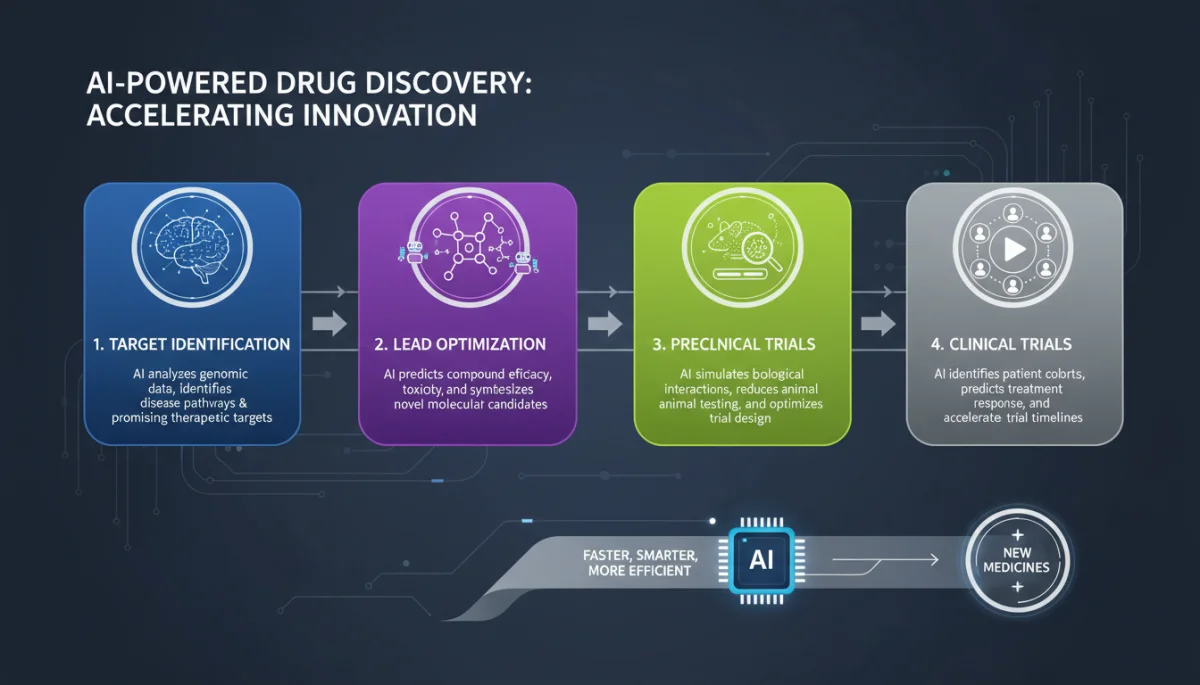
The traditional drug discovery pipeline is notoriously time-consuming and expensive, often taking over a decade and billions of dollars to bring a single drug from concept to patient. AI addresses these bottlenecks by optimizing various stages, from initial target identification to lead compound optimization and even predicting clinical trial outcomes. This efficiency gain is critical for addressing unmet medical needs and responding to global health crises with greater agility.
Revolutionizing target identification and validation
One of the earliest and most crucial steps in drug discovery is identifying suitable biological targets. These are molecules within the body, such as proteins or genes, that are implicated in a disease process and can be modulated by a drug. Traditionally, this has been a laborious process involving extensive biological research and experimentation.
- Genomic and proteomic data analysis: AI algorithms can sift through massive genomic and proteomic datasets to pinpoint novel disease targets with higher precision than conventional methods.
- Disease pathway mapping: Machine learning models can analyze complex biological pathways, identifying key nodes that, when targeted, could have a significant therapeutic effect.
- Predictive modeling: AI can predict the likelihood of a target being ‘druggable’ based on its structural characteristics and known interactions, saving valuable research time.
By streamlining target identification, AI ensures that researchers focus their efforts on the most promising avenues, reducing the rate of early-stage failures. This intelligent prioritization is a cornerstone of accelerating the entire drug development timeline.
In essence, AI acts as a sophisticated guide, illuminating the most effective paths through the intricate maze of biological data. This early-stage optimization is vital, as a well-chosen target can dramatically improve the chances of a drug’s success further down the line. The precision offered by AI means fewer resources are wasted on less promising targets, directly contributing to the overall speed and cost-effectiveness of drug development.
Anúncios
Accelerating lead discovery and optimization with AI
Once a promising target is identified, the next critical phase involves discovering and optimizing lead compounds – molecules that can bind to the target and modulate its activity. This stage, often referred to as lead discovery and optimization, is where AI truly shines by transforming a largely trial-and-error process into a more directed and efficient endeavor.
Historically, chemists would synthesize and test thousands, sometimes millions, of compounds in a high-throughput screening process. While effective, this method is resource-intensive and often yields many false positives or compounds with suboptimal properties. AI offers a smarter, more targeted approach.
In silico screening and de novo design
AI algorithms can perform ‘in silico’ (computer-based) screening of vast chemical libraries, predicting how different molecules will interact with a specific biological target. This virtual screening significantly narrows down the pool of candidates before any laboratory synthesis begins, saving considerable time and resources.
- Virtual compound libraries: AI can rapidly screen billions of virtual compounds, identifying those with the highest predicted affinity and desired biological activity.
- De novo drug design: Beyond screening existing compounds, AI can generate novel molecular structures from scratch, designed specifically to fit the target’s binding site and possess optimal drug-like properties.
- Property prediction: AI models can predict various physiochemical and ADMET (absorption, distribution, metabolism, excretion, and toxicity) properties of compounds, helping to filter out molecules likely to fail due to poor pharmacokinetics or safety concerns.
This predictive power allows researchers to focus on synthesizing and testing only the most promising candidates, drastically reducing the experimental workload. The ability to design new molecules with desired characteristics is a game-changer, moving beyond simply finding existing ones.
The iterative process of lead optimization, where compounds are modified to improve their efficacy, safety, and pharmacokinetic profile, also benefits immensely from AI. Machine learning models can predict the impact of structural changes on a compound’s properties, guiding chemists toward optimal modifications. This intelligent iteration shortens the optimization cycle, bringing effective drug candidates to preclinical testing much faster.
AI’s impact on preclinical and clinical development phases
The journey of a drug candidate doesn’t end with lead optimization; it must successfully navigate rigorous preclinical and clinical development phases. These stages are often the longest and most expensive, characterized by high attrition rates. AI is now being deployed to enhance the efficiency and success rates of these critical phases.
Preclinical studies involve testing drug candidates in laboratory settings and animal models to assess safety and efficacy before human trials. Clinical trials, the final hurdle, evaluate the drug’s safety and effectiveness in humans across several phases. Both stages are fraught with challenges, from predicting toxicity to recruiting suitable patients.
Improving preclinical safety and efficacy prediction
One of the primary reasons drug candidates fail in clinical trials is unexpected toxicity or lack of efficacy. AI can help mitigate these risks during the preclinical stage.
- Toxicity prediction: Machine learning models trained on vast datasets of chemical structures and toxicity profiles can predict potential adverse effects of new compounds with greater accuracy.
- Efficacy modeling: AI can analyze preclinical data to better predict how a drug might behave in human physiological systems, improving the translatability of animal study results.
- Biomarker discovery: AI assists in identifying novel biomarkers that can indicate a drug’s effectiveness or potential side effects early on, guiding development decisions.
By providing more accurate predictions, AI helps researchers make informed decisions about which compounds to advance, reducing the likelihood of costly failures in later stages. This proactive risk assessment is invaluable.
Optimizing clinical trial design and execution
Clinical trials are complex undertakings, often hampered by challenges in patient recruitment, trial design, and data analysis. AI offers solutions across these areas.
- Patient identification and recruitment: AI algorithms can analyze electronic health records (EHRs) to identify eligible patients for specific trials more efficiently, accelerating recruitment.
- Trial protocol optimization: Machine learning can help design more adaptive and efficient clinical trial protocols, potentially reducing the number of patients needed or shortening trial durations.
- Data analysis and monitoring: AI tools can continuously monitor trial data, identify trends, detect adverse events earlier, and provide real-time insights, enabling quicker decision-making.
The ability of AI to streamline clinical trials is profound. Faster patient recruitment means trials can start and finish sooner. Optimized trial designs lead to more conclusive results with fewer participants. Real-time data analysis allows for agile adjustments, minimizing delays and maximizing the chances of success. This comprehensive support from AI across preclinical and clinical phases is a major driver behind the projected three-year acceleration in drug development.
Economic implications and competitive advantages for the US
The acceleration of drug development through AI carries significant economic implications for the United States, solidifying its position as a global leader in pharmaceutical innovation. Reducing the time and cost associated with bringing new drugs to market offers multifaceted benefits, from increased R&D productivity to enhanced global competitiveness.
The pharmaceutical industry is a cornerstone of the US economy, contributing substantially to GDP, employment, and export revenues. Any efficiency gains within this sector have ripple effects throughout the broader economic landscape. AI’s ability to shorten development cycles directly translates into financial savings and earlier revenue generation for pharmaceutical companies.
Cost reduction and R&D efficiency
The average cost to develop a new drug is staggering, often exceeding $2 billion. A significant portion of this cost is attributed to the high failure rates and the extensive time required for development. AI addresses both of these factors.
- Reduced failure rates: By improving predictions of efficacy and toxicity earlier in the pipeline, AI decreases the number of drug candidates that fail in late-stage trials, saving billions in wasted R&D investment.
- Optimized resource allocation: AI-driven insights allow pharmaceutical companies to allocate their research budgets more effectively, focusing on the most promising projects and minimizing expenditure on less viable ones.
- Faster market entry: Shaving years off the development timeline means drugs can reach the market sooner, allowing companies to recoup their R&D investments and generate revenue more quickly.
These efficiencies translate into substantial savings that can be reinvested into further innovation, creating a virtuous cycle of scientific advancement and economic growth. The ability to do more with less, or more accurately, to do more with smarter strategies, is a key economic advantage.
Strengthening US pharmaceutical leadership
The early and robust adoption of AI in drug discovery provides the US with a distinct competitive edge on the global stage. Nations and companies that effectively leverage AI will be at the forefront of medical breakthroughs.
- Innovation hub: The US already boasts a robust ecosystem of biotech startups, academic research institutions, and large pharmaceutical companies. AI integration further solidifies its status as a global innovation hub.
- Talent attraction: Leadership in AI-driven drug discovery attracts top scientific and technological talent from around the world, fostering a dynamic and innovative workforce.
- Global health impact: Faster drug development means the US can more rapidly address global health challenges, from emerging pandemics to chronic diseases, enhancing its influence and humanitarian contributions worldwide.
By leading the charge in AI-powered drug discovery, the US not only secures its economic prosperity but also reinforces its role as a key player in advancing global health. This strategic advantage ensures continued investment and innovation within the nation’s pharmaceutical sector for years to come.
Challenges and considerations in AI adoption
While the potential of AI in drug discovery is immense, its widespread adoption and full realization are not without challenges. Navigating these complexities requires a concerted effort from industry, academia, and regulatory bodies to ensure that the technology is implemented responsibly and effectively.
The integration of any transformative technology brings forth a new set of considerations, ranging from data infrastructure to ethical implications. Addressing these challenges proactively is crucial for unlocking the full benefits of AI in pharmaceutical development.
Data quality and accessibility
AI models are only as good as the data they are trained on. In pharmaceutical research, this often means dealing with vast, heterogeneous, and sometimes siloed datasets.
- Data standardization: A lack of standardized data formats across different research institutions and companies can hinder the effective training of AI models.
- Data privacy and security: Handling sensitive patient data for AI training requires robust privacy safeguards and secure infrastructure to comply with regulations like HIPAA.
- Data availability: Access to high-quality, diverse datasets, especially for rare diseases or specific patient populations, remains a significant hurdle.
Overcoming these data-related challenges requires significant investment in data infrastructure, interoperability standards, and secure data-sharing agreements. Without high-quality and accessible data, AI’s predictive power is limited.
Regulatory frameworks and ethical concerns
The rapid advancement of AI often outpaces the development of regulatory guidelines, creating uncertainty for pharmaceutical companies.
- Regulatory clarity: There’s a need for clear guidance from regulatory bodies like the FDA on how AI-generated insights and AI-designed drugs will be evaluated and approved.
- Explainability of AI: Many advanced AI models operate as ‘black boxes,’ making it difficult to understand how they arrive at their conclusions. Regulators and scientists require explainable AI (XAI) to ensure transparency and trustworthiness in drug development.
- Ethical considerations: The use of AI in medicine raises ethical questions, such as potential biases in data leading to biased drug development, and the appropriate level of human oversight in AI-driven decisions.
Establishing robust ethical guidelines and adaptive regulatory frameworks is essential to foster innovation while ensuring patient safety and public trust. Collaborative efforts between technology developers, pharmaceutical companies, and regulatory agencies will be vital in shaping the future of AI-driven drug discovery.
The future landscape: Beyond 2026
Looking beyond the immediate projection of a three-year acceleration by 2026, the long-term impact of AI on US pharmaceutical development promises even more profound transformations. The current advancements are just the beginning of a sustained revolution that will continually reshape how we approach health and medicine.
As AI technologies mature and become more integrated into every facet of drug discovery, we can anticipate even greater efficiencies, more personalized treatments, and a fundamental shift in the entire healthcare ecosystem. The future will likely see a blurring of lines between computational biology, chemistry, and clinical practice.
Personalized medicine and precision therapeutics
One of the most exciting long-term prospects is the acceleration of personalized medicine. AI can analyze an individual’s genetic makeup, lifestyle, and medical history to predict their unique response to different drugs.
- Patient-specific drug design: AI could eventually enable the design of drugs tailored not just to a disease, but to an individual patient’s specific biological profile, maximizing efficacy and minimizing side effects.
- Predictive diagnostics: AI will enhance diagnostics, allowing for earlier and more precise identification of disease, enabling proactive treatment strategies.
- Optimized treatment plans: For existing conditions, AI can help clinicians select the most effective treatment regimen for each patient, moving away from a one-size-fits-all approach.
This shift towards precision therapeutics promises a future where treatments are far more effective and less burdensome for patients, leading to better health outcomes and a more efficient healthcare system overall. The ability to customize therapies will be a hallmark of AI’s enduring legacy.
Continuous innovation and adaptive drug development
AI fosters an environment of continuous learning and adaptation within the drug development pipeline. As more data is generated and analyzed, AI models will become increasingly sophisticated, leading to an iterative cycle of improvement.
- Autonomous discovery platforms: We may see the emergence of highly automated AI platforms capable of conducting entire segments of the drug discovery process with minimal human intervention.
- Real-time drug repurposing: AI can rapidly identify existing drugs that could be repurposed for new indications, accelerating the availability of treatments for emerging diseases or unmet needs.
- Preventative medicine: Beyond treatment, AI’s predictive capabilities could play a larger role in preventative medicine, identifying individuals at high risk for certain diseases and recommending early interventions.
The future of AI in US pharmaceutical development is one of relentless innovation, where the process of bringing new medicines to humanity becomes faster, smarter, and more targeted than ever before. The gains projected for 2026 are merely the first significant milestones in a journey that promises to redefine healthcare for generations.
| Key Aspect | Impact of AI |
|---|---|
| Development Speed | Projected acceleration of 3 years by 2026, bringing drugs to market faster. |
| Cost Efficiency | Reduces R&D costs by minimizing failures and optimizing resource allocation. |
| Innovation & Precision | Enables novel drug design, personalized medicine, and more accurate predictions. |
| US Leadership | Strengthens the US as a global leader in pharmaceutical innovation and healthcare. |
Frequently asked questions about AI in drug discovery
AI accelerates drug discovery by optimizing every stage: identifying disease targets, rapidly screening and designing drug candidates, predicting their efficacy and toxicity, and streamlining clinical trial design and patient recruitment. This reduces the time and resources traditionally consumed by manual processes and trial-and-error approaches.
For patients, the main benefits include faster access to new, life-saving medications, potentially more effective and personalized treatments due to AI’s precision, and a reduction in the side effects of drugs through better toxicity prediction. This translates to improved health outcomes and quality of life.
Key challenges include ensuring high-quality and accessible data for AI training, developing robust and clear regulatory frameworks for AI-driven discoveries, addressing ethical concerns like data bias, and overcoming the ‘black box’ problem of AI models to ensure their explainability and trustworthiness.
No, AI is not expected to replace human scientists but rather augment their capabilities. AI handles data-intensive, repetitive tasks and provides powerful insights, freeing scientists to focus on complex problem-solving, hypothesis generation, and experimental design. It’s a collaborative partnership, enhancing human ingenuity.
By significantly reducing the time and failure rates in drug development, AI has the potential to lower the overall R&D costs for pharmaceutical companies. While initial savings might be reinvested, in the long term, these efficiencies could contribute to making new medications more affordable and accessible to a wider population.
Conclusion
The integration of artificial intelligence into the US pharmaceutical development pipeline represents a monumental shift, promising to accelerate drug discovery by an estimated three years by 2026. This transformation is not merely about speed; it encompasses enhanced precision in target identification, efficiency in lead optimization, and improved success rates in preclinical and clinical trials. While challenges related to data quality, regulation, and ethics remain, the economic advantages and the potential for personalized medicine are too significant to ignore. As AI continues to evolve, its enduring impact will redefine healthcare, ushering in an era of faster, smarter, and more effective treatments for patients across the nation and globally, solidifying the US’s leadership in biomedical innovation.