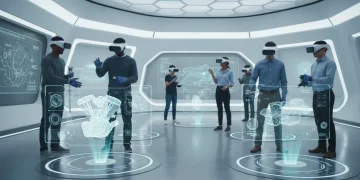
Holographic Communication: 5% US Business Adoption by 2026?

Anúncios
Achieving a 5% adoption rate for holographic communication adoption among US businesses by 2026 is highly optimistic, contingent on rapid advancements in cost reduction, infrastructure, and user experience that currently present significant barriers.
The concept of holographic communication adoption, once confined to science fiction, is rapidly approaching reality, promising to revolutionize how US businesses connect and collaborate. This technology offers an immersive, three-dimensional experience that could bridge geographical distances like never before. But how realistic is a 5% adoption rate among US businesses by the ambitious target of 2026?
Anúncios
Understanding Holographic Communication Technology
Holographic communication represents a significant leap beyond traditional video conferencing, offering a truly immersive, three-dimensional presence. It goes beyond flat screens, projecting realistic, interactive 3D images of people or objects into a physical space, allowing for more natural and engaging interactions.
This technology relies on sophisticated optical systems, advanced sensors, and high-speed data transmission. Unlike virtual or augmented reality, which typically require headsets, true holographic communication aims for a glasses-free, shared experience. The goal is to make remote participants feel as if they are physically present in the same room.
Core Technological Components
Several key components underpin the development of practical holographic communication systems. Each element must advance significantly to enable widespread business adoption.
- High-Resolution Displays: Achieving lifelike holograms demands displays with incredibly high pixel density and refresh rates, far surpassing current consumer-grade technology.
- Real-time 3D Capture: Sophisticated camera arrays and depth sensors are needed to capture a person or object in 3D, processing this data instantly for transmission.
- High-Bandwidth Networks: Transmitting massive amounts of 3D data in real-time requires ultra-low latency and extremely high-bandwidth networks, such as 5G and future 6G infrastructure.
- Advanced Rendering Engines: Powerful processors and specialized software are essential to render and project these complex 3D images without lag or distortion.
The convergence and maturation of these technologies are crucial for any significant market penetration. While prototypes exist, integrating them into a stable, scalable, and affordable business solution remains a substantial challenge.
In conclusion, holographic communication is not a singular technology but a complex ecosystem of interconnected advancements. Its practical application in business hinges on the synergistic development of these core components, which are still in various stages of research and development.
Current State of Holographic Communication in 2024
As of 2024, holographic communication is largely in its nascent stages, primarily showcased through impressive prototypes and specialized applications rather than widespread commercial deployment. While the wow factor is undeniable, the journey from demonstration to everyday business tool is long and complex.
Anúncios
Several companies and research institutions are actively pursuing different approaches to holographic projection. Some focus on light-field displays, others on volumetric displays, and some on hybrid solutions. Each method has its own set of advantages and limitations regarding resolution, field of view, and interactivity.
Pioneering Projects and Early Adopters
Early examples of holographic technology in action provide a glimpse into its potential, though these are often high-cost, bespoke solutions.
- Event-based Projections: Famous examples include musical performances or large-scale presentations where deceased artists or remote speakers appear as holograms. These often use Musion Eyeliner or similar projection techniques, which are not true interactive holography.
- Medical Imaging: Some medical facilities are experimenting with holographic displays for visualizing complex anatomical structures, aiding in diagnostics and surgical planning. This is a niche application with high value.
- Industrial Design and Prototyping: Automotive and aerospace industries are exploring holographic visualization for collaborative design reviews, allowing engineers to interact with 3D models in a shared space.
These early applications highlight the technology’s promise but also underscore its current limitations, particularly regarding scalability, cost, and the need for highly controlled environments. The transition from these specialized uses to general business communication is a monumental task.
The current landscape indicates that while the technology is progressing, it is far from being a plug-and-play solution. Most existing holographic solutions are expensive, require significant technical expertise to set up and operate, and often lack the seamless interactivity needed for routine business use. This makes a 5% adoption rate by 2026 a very aggressive forecast.
Challenges to Widespread Business Adoption by 2026
Achieving even a modest 5% adoption rate for holographic communication adoption in US businesses by 2026 faces numerous formidable challenges. These hurdles span technological, economic, and logistical domains, requiring significant breakthroughs and investments.
The primary barrier remains the cost. Current holographic systems are incredibly expensive, placing them far out of reach for most small to medium-sized businesses and even many large corporations for general use. Reducing manufacturing costs for components and integrating them into affordable, user-friendly devices is paramount.
Key Obstacles to Overcome
Several critical factors impede rapid integration into the corporate environment.
- Technological Maturity and Reliability: The technology is still evolving. Issues like image fidelity, field of view, refresh rates, and the ability to project full-color, interactive holograms reliably in varied lighting conditions need further refinement.
- Infrastructure Requirements: Widespread adoption demands robust, high-speed, low-latency network infrastructure. While 5G is expanding, ubiquitous, high-quality connectivity capable of handling real-time 3D data streams is not yet a reality across all US business locations.
- User Experience and Interoperability: Systems need to be intuitive and easy to use without extensive training. Furthermore, interoperability standards must emerge to allow different holographic systems to communicate seamlessly, preventing fragmentation.
- Content Creation and Integration: Creating 3D content for holographic presentations, training, or product demonstrations is complex and requires specialized skills and tools. Integrating this into existing business workflows will be a significant undertaking.
- Scalability and Portability: Many current holographic solutions are bulky and require dedicated spaces. For widespread adoption, systems need to become more compact, portable, and adaptable to various office environments.
These challenges are interconnected. For instance, reducing cost often depends on technological maturity and mass production, which in turn requires market demand that is currently constrained by cost and infrastructure. Overcoming these will require a concerted effort from innovators, infrastructure providers, and businesses themselves.
In summary, the path to widespread business adoption is paved with significant technical and economic challenges. While progress is being made, the timeline for overcoming these sufficiently to reach 5% penetration by 2026 appears highly ambitious, suggesting a more gradual rollout.
Potential Benefits for US Businesses
Despite the challenges, the transformative potential of holographic communication for US businesses is immense, offering advantages that could fundamentally alter remote work, collaboration, and customer engagement. The benefits extend beyond mere novelty, promising tangible improvements in efficiency, understanding, and personal connection.
One of the most significant advantages is the enhanced sense of presence and immersion. Unlike 2D video calls, holographic interactions can foster a deeper connection, reduce miscommunication due to non-verbal cues, and make remote collaboration feel more like in-person meetings. This could be particularly valuable for globally distributed teams.
Transformative Applications Across Industries
The impact of holographic communication could be felt across various sectors, creating new opportunities and optimizing existing processes.
- Remote Collaboration and Meetings: Teams could conduct meetings where participants appear as lifelike holograms, allowing for natural eye contact, shared physical space for 3D models, and more effective brainstorming sessions.
- Training and Education: Complex machinery, medical procedures, or intricate designs could be demonstrated holographically, offering highly immersive and interactive training experiences that are safer and more effective than traditional methods.
- Product Design and Prototyping: Engineers and designers could collaboratively manipulate and review 3D product prototypes in a shared holographic space, accelerating development cycles and reducing the need for physical models.
- Customer Engagement and Sales: Businesses could showcase products or services to customers as interactive holograms, providing a richer, more engaging experience than traditional online catalogs or videos. Think of holographic showrooms or virtual product demos.
- Healthcare: Surgeons could consult with specialists globally, projecting patient scans or even live surgery feeds as holograms for collaborative analysis and guidance.
These applications underscore the strategic value holographic communication could bring. The ability to visualize and interact with 3D information in a shared virtual-physical space could unlock new levels of innovation and operational efficiency. Businesses that successfully integrate this technology could gain a significant competitive edge.
Ultimately, the benefits of holographic communication are compelling enough to drive continued investment and development. The enhanced realism and interactivity it offers could lead to breakthroughs in how businesses operate, collaborate, and engage with their stakeholders.
Factors Influencing Adoption Rate by 2026
Several critical factors will determine the pace at which US businesses adopt holographic communication by 2026. The interplay of technological readiness, economic viability, and market demand will largely dictate whether the ambitious 5% target is met or if adoption remains a niche phenomenon.
The rate of technological advancement, particularly in reducing device size, improving display quality, and enhancing real-time processing capabilities, is paramount. If innovation accelerates faster than anticipated, it could push adoption forward. Conversely, slower progress would inevitably delay widespread uptake.
Key Drivers and Inhibitors
Understanding the forces that will either propel or hinder holographic communication adoption is crucial for forecasting its market penetration.
- Cost Reduction: This is arguably the most significant factor. As production scales and technology matures, prices for holographic hardware and software must drop significantly to be accessible to a broader range of businesses.
- Network Infrastructure Development: The rollout and stability of 5G and future 6G networks are essential. Businesses need reliable, high-bandwidth connections to support the data-intensive nature of holographic communication.
- Standardization and Interoperability: The emergence of industry standards will be vital for ensuring different holographic systems can communicate seamlessly, fostering a more cohesive and attractive market.
- Ease of Use and Integration: Systems must be user-friendly and easily integrate into existing IT infrastructures and workflows without requiring extensive overhauls or specialized personnel.
- Killer Applications: The development of compelling, business-critical applications that clearly demonstrate a strong return on investment (ROI) will be a major driver for adoption.
- Competitive Landscape: The pace of development in competing immersive technologies (e.g., advanced VR/AR) could either accelerate or slow holographic adoption depending on their relative strengths and weaknesses.
Government initiatives, research funding, and the emergence of major tech players investing heavily in holographic solutions could also significantly influence the trajectory. A strong ecosystem of developers, service providers, and content creators will be necessary to support widespread deployment.
In conclusion, while the potential is clear, the actual adoption rate will be a complex function of how quickly these enabling factors align. The window to 2026 is tight, suggesting that a 5% adoption would require a perfect storm of positive developments across these diverse areas.
Forecasting 5% Adoption by 2026: A Realistic Outlook
Given the current state of technology, the formidable challenges, and the various influencing factors, assessing the realism of a 5% adoption rate for holographic communication adoption among US businesses by 2026 requires a balanced perspective. While optimistic, it appears to be a highly ambitious target.
Historically, transformative technologies often follow an S-curve adoption model, starting slowly in niche applications before accelerating. Holographic communication is still very much in the early, experimental phase of this curve. For it to reach 5% penetration in just two years, it would need an unprecedented acceleration in maturation and market acceptance.
Factors Weighing Against Rapid Adoption
Several elements suggest a more conservative adoption timeline.
- Immense Cost: The price point for enterprise-grade holographic systems remains prohibitive for all but the largest and most specialized businesses. Significant cost reduction typically takes more than a couple of years.
- Infrastructure Gap: While 5G is expanding, universal, high-quality, and low-latency connectivity is not yet a given across all US business locations, especially for the demanding data requirements of holography.
- Lack of Standardized Ecosystem: The absence of widely accepted hardware and software standards makes it difficult for businesses to invest confidently, fearing obsolescence or incompatibility.
- Integration Complexity: Implementing new, complex technologies requires significant IT resources, training, and workflow adjustments, which often take time to plan and execute.
Considering these points, a 5% adoption rate by 2026 seems more aspirational than realistic for general business use. It’s more plausible that by 2026, we will see continued strong growth in specialized, high-value sectors (like advanced manufacturing, medicine, or large-scale entertainment) where the ROI justifies the high cost and complexity.

However, if a major tech giant were to launch a surprisingly affordable, user-friendly, and highly functional holographic communication solution within the next year, coupled with widespread network upgrades, then a faster adoption rate might become feasible. This scenario, while possible, is not the most probable based on current trajectories.
In conclusion, while the vision of holographic communication adoption is compelling, a 5% penetration rate by 2026 for US businesses broadly is likely an overestimation. A more realistic outlook suggests that by 2026, the technology will still be primarily in the hands of early adopters and specialized industries, paving the way for broader adoption in the later half of the decade.
The Path Forward: Accelerating Holographic Integration
For holographic communication to achieve a significant adoption rate in US businesses, even beyond 2026, a concerted effort across several fronts is essential. The path forward involves not just technological breakthroughs but also strategic market development and ecosystem building.
Key to acceleration will be the development of more accessible and affordable solutions. This means moving beyond bespoke, multi-million-dollar installations to more compact, scalable devices that can integrate into standard office environments and budgets.
Strategies for Future Growth
Several strategies can help push holographic communication into the mainstream business environment.
- Democratization of Hardware: Manufacturers need to focus on mass-producing more affordable, consumer-grade (but business-ready) holographic projectors and capture devices.
- Software and Platform Development: User-friendly software platforms with intuitive interfaces and robust features for collaborative work, content creation, and integration with existing business tools will be crucial.
- Network Enhancement: Continued investment in 5G and 6G infrastructure, ensuring reliable, high-speed, and low-latency connectivity across urban and rural business centers.
- Industry Partnerships: Collaborations between tech companies, telecommunication providers, and leading businesses can drive innovation, pilot programs, and the development of industry-specific solutions.
- Education and Awareness: Businesses need to be educated on the tangible benefits and ROI of holographic communication, moving beyond the perception of it as a novelty.
- Regulatory Frameworks: As the technology evolves, clear regulatory guidelines for data privacy, security, and ethical use will build trust and facilitate adoption.
The role of venture capital and government funding in supporting research and development, as well as pilot projects, cannot be overstated. These investments can help bridge the gap between cutting-edge prototypes and market-ready products.
In conclusion, while 2026 might be too soon for widespread holographic communication adoption at the 5% mark, the subsequent years could see rapid growth if these strategies are effectively implemented. The foundation laid in the next few years will be critical for determining the long-term trajectory of this transformative technology in the US business landscape.
| Key Point | Brief Description |
|---|---|
| Current Status | Holographic communication is largely in prototype and specialized application stages, not widespread commercial use. |
| Key Challenges | High cost, infrastructure demands, technological maturity, and lack of standards hinder rapid adoption. |
| Potential Benefits | Enhanced remote collaboration, immersive training, and innovative customer engagement are major advantages. |
| 2026 Outlook | A 5% adoption rate by 2026 is highly ambitious; more realistic for specialized sectors before broader market penetration. |
Frequently Asked Questions About Holographic Communication
Holographic communication projects 3D images into real space, viewable without headsets, offering a shared physical experience. VR immerses users in a fully virtual world, while AR overlays digital information onto the real world, both typically requiring headsets.
The high cost stems from the advanced, specialized components required, such as high-resolution light-field displays, complex 3D capture systems, and powerful real-time rendering engines, which are not yet mass-produced.
Effective holographic communication requires ultra-high bandwidth and extremely low latency, typically demanding stable 5G or future 6G networks to transmit the vast amounts of real-time 3D data without lag or distortion.
Industries with high-value applications, such as healthcare (surgical planning, remote consultation), advanced manufacturing (design, prototyping), and specialized entertainment, are the most probable early adopters due to the significant ROI potential.
While it offers a more immersive experience, holographic communication is unlikely to fully replace traditional video conferencing by 2026 due to cost and infrastructure. It will likely complement it, serving specialized, high-impact use cases initially.
Conclusion
The dream of holographic communication adoption in US businesses by 2026, particularly at a 5% rate, presents a fascinating intersection of technological ambition and market reality. While the potential for transformative impact on collaboration, training, and customer engagement is undeniable, the journey from cutting-edge prototype to widespread commercial tool is fraught with significant hurdles. Cost, infrastructure limitations, technological maturity, and the need for seamless integration all combine to suggest that while progress will be made, broad adoption by the target year remains highly optimistic. The coming years will undoubtedly see continued innovation, paving the way for a future where holographic presence is more common, but likely beyond the immediate horizon of 2026 for a substantial market share.